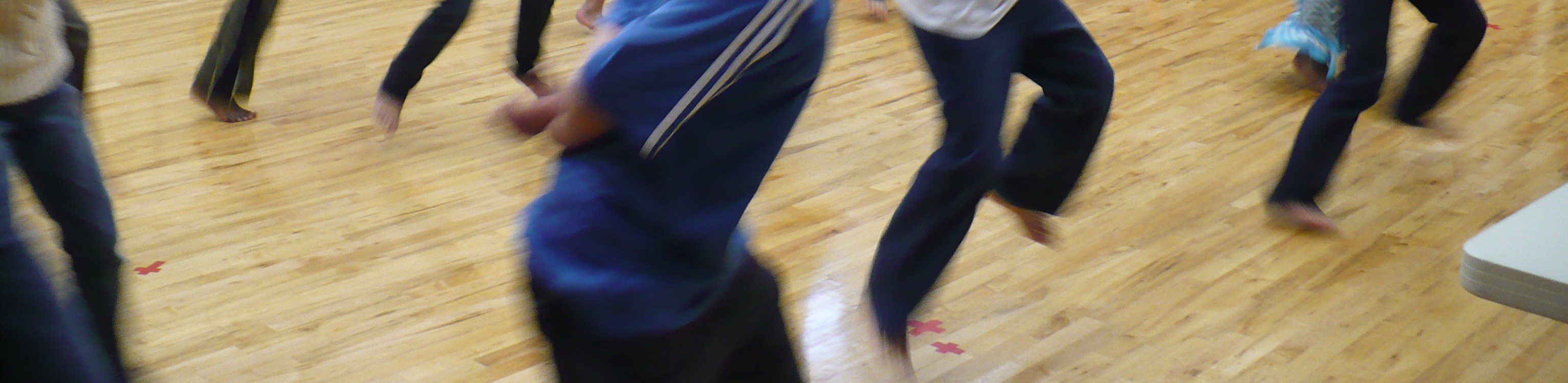
Alimah and Farihah are my students. They’re both cheerful, attentive, kind, lively, quick, and participatory. Alimah, a 1st grader, is shy, but she’s a great partner for anyone in the class. Any student, boy or girl, calm or wildly off-task, gets their work done when paired with her, because she can be on-task and have fun at the same time. Her sister, Farihah, is in 2nd grade, and she’s joyful and happy, as her name suggests.* She’s also a great partner, but not a bit shy. She loves to demonstrate, with me or with a fellow student, doing a practiced move or trying something for the first time.
It’s such a pleasure to dance with these girls. They dance as if they love it, and they offer so much to their classmates, as we develop movement skills, learn cultural dances from around the world, and choreograph dances to express ideas and feelings from the classroom. They thrive in this public school classroom, where dance as a fine art qualifies as one of the required content areas for a model education.
But I feel such sadness as I look ahead, because they’re bound to experience tremendous conflict in my classroom. Although they’ll remain their friendly selves outside my class, open & enthusiastic in their greetings, their presence inside the classroom will change: movements restrained, participation reserved, and expressions guarded or even sullen.
Last month, their father contacted me with a request to remove them from dance class. Although my school has families for whom dance is not acceptable, that was not the main issue in this case. In this case, his note cited religious restrictions on cross-gender contact (especially touching) and listening to music. He asked to have them placed somewhere else during dance class.
There are several things he didn’t realize. First, within a public school, there’s no surplus of adults to supervise children who want to be somewhere else. And second, given research suggesting that music and dance support academic achievement in positive ways, you can’t escape music by moving from one location to another in a public school. Every teacher is encouraged to integrate the arts!
We met & talked, Dad, myself, the girls’ teachers, the principal. I can — and d0 — offer alternatives to cross-gender contact. I teach that anyone can be your learning partner, in dance as well as science, reading, or math. But we explore ways of being connected without touch, as you would in science, reading, or math. Picture two partners facing each other, with hands palm-to-palm — not touching but with a 2″ cushion of space between the palms. Students can do space-between elbow swings, space-between leading and following, space-between turns.
But music! How can you take music out of dance class? …when all the children love it? In deference to families that feel the conflict between their traditions and the society in which they find themselves living, I already limit our musical repertoire: instrumental selections that offer rhythmic variety, clear listening cues, and lyrics chosen to support educational concepts and content. But music & dance are interwoven, through energy, accuracy, synchronicity & just plain fun.
So we’re stuck, I with my experience of what music can offer, and the girls with their developing awareness of how music is viewed at home. I with my vision of how the girls will be affected over the years to come, and the girls, as yet unaware of how life in two cultures will feel.
If you have a clue that will help me teach these beautiful children, please share your ideas!
*Of course, I changed their names for this article, choosing names to fit the personalities I know: Alimah means “dancer or musician,” and Farihah means “joyful, happy, cheerful, and glad.”
Comparatively, I have limited experience working in the public school classroom, as I just graduated from college with my dance degree, but I can understand how difficult that situation is. It is very tough to think of removing students from what we see as a wonderful educational experience. I recall that the most valuable times in my education were the times spent discovering myself, and opening my eyes to new worlds and experiences.
Because of my experiences and education, I should preface my comments with the fact that I have established myself as an atheist. I feel that my neutrality of any religious doctrine has allowed me to make judgements about ethical issues based on my own perception of morality, rather than relying on a pre-existing set of religious ideas.
It is tragic to see young children that know nothing about their world being held behind a curtain of rules that prevent them from openly learning and growing.
Legally of course, the parents have every right to prevent their child from doing anything in school. People have every right to homeschool their children and tell them that zeus makes lightning, sadly their children will grow up with a very limited and clouded view of their world. They are being coerced into practices and ideas that are not their own. The simplest of human pleasures like music are what make the world beautiful and fulfilling. Its a shame that they are not allowed see that, and pulling students out of an activity only reinforces their feelings of being an outsider to their peers.
I really don’t think there is anything you can do beyond speaking with the parents. Since you have already done that, it seems that they aren’t willing to budge about the issue. If they see your class (which I am sure is fabulous) as damaging to their children, then you really have no other option but to honor their request. I suppose that the only chance you have at keeping the two children in your class is the logistics. There aren’t people standing around in a school waiting to supervise kids that don’t take part in classroom activities.
Posting on your blog and NDEO, asking your colleagues for thoughts on this issue is proof that you are a considerate and thoughtful educator. There are many ways to deal with this issue, and you have not taken this situation lightly. Feel free to e-mail me if you want to chat anytime. I crave growing and learning as an educator myself, and I would love to hear how everything goes.
Thanks so much for your careful reading, Sam! I really appreciate the responses I’ve received both here & on the NDEO Forum. I’ll be mulling this issue over for a long time — as long as I have these students — and trying various approaches. My hope is to maintain the kids’ participation for as long as possible, for their sake & for the sake of our dancing community!
Too much to ask: dance without music, revisited // Feb 4, 2012 at 12:01 am
[…] posted my article “Too much to ask: dance without music” (about religious restrictions on music in a dance classroom) to a forum of fellow dance […]
I feel you. I dance at festivals, in class, by myself, and always to music. I’ve recently been experience with focus and being exercises however, and dancing in silence is one of them.
Dance. It is a beautiful release for me. It is my meditation. I’m not a still person, and I feel awkward in the presence of silence. My mind works all the time, even when I try to numb it. Since leaving Santa Cruz and getting back to Laguna I have been quietly isolated, and so I retreat in to the headphones most of the day. I busy my hands with preoccupations.
I have broken from habitual consumption. Cigarettes, sacrament (which I turned into my habit a long time ago), and I was never much of a drinker, just the occasional wine or micro brew in modest intake. But I had to turn it into a rule. I had to ‘quit.’ I’ve never been addicted. If I go to a place where there is no smoking allowed, maybe an ashram or yoga retreat or dance workshop for extended periods, even weeks at a time, I’m secretly happy to have to stop smoking. But writing is an intense association for those practices. My mind is working all time, and it’s focused thoroughly on its thoughts. Internal silence is difficult, if nigh impossible to attain, and frankly not a requisite for most writers. My writing requires full time– overtime — productivity of thought. The wheel must always be turning. I forget to breathe. I am seeing through other eyes. There are shamanic moments, but analysis is always prying at those stark trances of information output. I’ve learned to get up and walk around as a break from piling up the ashtray, and I’ve learned to make tea a new habit. My writing seems inextricably linked with stimulation. I’m not sure where that came from, but I know it’s not required.
Focus is the only true refuge, and unlike the whim of imagination or the quip of analysis, focus is not an after thought for me; it takes real determination and discipline. It takes a great surmounting of will to hold focus for hours.
Associations with my activities creep up everywhere, but tonight I played with a very stealthy and easily overlooked associated stimulation. Tonight I danced and danced for hours without music. I’ve noticed, at least with myself, that there is a competition — even a playful and innocent exchange — between the dance and the sound. When I watch other dancers I notice they are lost in the music, and the dance reflects that. Their body reiterates the sound, and there is conjunction. But there was a powerful awe tonight in dancing silently to the light of the full moon.
In the beginning I felt myself imagining the music. It was powerful focus to be sure. But to harmonize myself more specifically, more intently on the act at hand, I tried to feel my body through to its swaying core, and find a silent song that was neither the sound of nature nor my own imagination. It was the sound of my body dancing to silence. I have never felt so utterly devoted to the moment. There was nothing to contrast, nothing to provoke me, and nothing to guide me, there was only doing what I had set out to do, and doing it entirely in its fullness. There was an infinite sense of being present for the moment in a way that has no association, accommodation or accomplice.
The sound of silence was like the color white, and inside that color I felt all the colors. The dance was a concentration of gesture and balance, abstracts of fast and slow, and improvisational timing. There was no song to dictate the sway, the progression, the build, climax and descent. There was the moment, and the moment was composed purely of the movement. There was no theme. Focus brought me to the present, and ultimately focus was a theme in and of itself. Dancing in silence felt as if my body were open to all the immanent expressions of nature, and moon light and darkness, and my mind wasn’t busy, but it was productively participating with my body.
It was neither joyous nor determined, stimulating nor preoccupying– it was infinitely being.